səlilwətaɬ (Tsleil-Waututh Nation)’s Treaty, Lands and Resources (TLR) Department, in partnership with the Kelp Rescue Initiative (KRI), have developed key findings, recommendations, and next steps for q̓am̓ (bull kelp) restoration and offsetting work in səlilwət (Burrard Inlet).
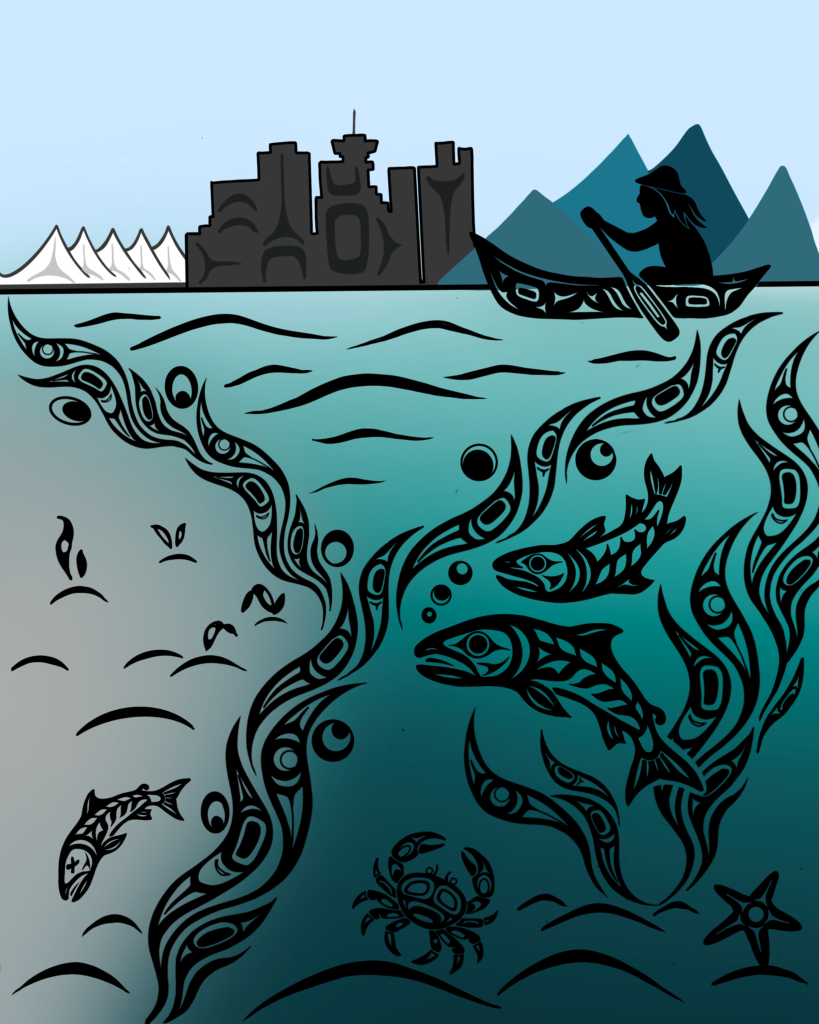
TLR and KRI have been working together on kelp restoration in Burrard Inlet since 2022. The focus of this work is to develop and refine bull kelp restoration methodologies tailored to the unique ecological conditions and logistical constraints within Burrard Inlet. In 2024, the team successfully grew bull kelp at restoration sites that persisted throughout the summer and was utilized by a variety of fish and invertebrate species.1,2,3
The guidance document outlines an active restoration approach that relies on outplanting kelp to sites with existing suitable substrate, rather than constructing artificial rock reefs or other hardened shoreline features commonly used in offsetting projects in Burrard Inlet. In addition to avoiding further shoreline hardening, this approach actively seeds target areas rather than relying on natural dispersal processes.

Prior to development, soft shorelines in Burrard Inlet supported eelgrass beds, salt marshes, clam beds, and forage fish beaches, sustaining many Tsleil-Waututh harvesting practices. Bull kelp forests were also abundant – Nation Members can still remember a time when the water was so thick with kelp that it was difficult to paddle through. Urbanization and industrialization have since caused extensive shoreline hardening and alteration reducing the area available to support these critical habitats and the harvesting practices they support.4,5,6,7
TLR prioritizes and supports the restoration and recovery of a diversity of habitats and species (including kelp) to restore the health of Burrard Inlet.8,9 Given the extensive cumulative loss of soft shoreline habitat throughout the inlet, restoration actions should avoid further shoreline hardening and associated impacts to nearshore ecosystems. With the information provided in the guidance document, TLR hopes restoration practitioners – especially those working within regulatory contexts – can implement kelp restoration approaches that do not rely on shoreline hardening and instead prioritize the active recovery of q̓am̓ in səlilwət.
This work has largely been funded by the City of Vancouver, World Wildlife Fund Canada, KRI and the Burrard Inlet Environmental Science and Stewardship Agreement. Field and lab components of the project were supported by SeaChange Marine Conservation Society, Pacific Science Enterprise Centre, and Bamfield Marine Sciences Centre. Artwork was created by Christopher Overes, and photos were supplied by KRI.
For more information about TLR’s kelp restoration and stewardship efforts, please contact Camryn Good, Environmental Specialist – Land, Water, and Environment, at camryngood@twnation.ca.
Further reading:
- TWN Blog: q̓am̓ Restoration in səlilwət: Collaborative Bull Kelp Restoration at Whey-ah-Wichen (Cates Park) and New Brighton Park
- North Shore News: Tsleil-Waututh Nation restores bull kelp in Burrard Inlet
- SFU Summit Research Repository: Collaborative exploration of novel bull kelp (Nereocystis luetkeana) restoration techniques in an urban ecosystem
- TWN Blog: Restoring a Healthy Inlet: An Interactive StoryMap Experience
- TWN Blog: Recent research on cumulative effects in Tsleil-Waututh territory
- TWN Blog: New Research Estimating Long-term and Large-scale Colonial Impacts on the Burrard Inlet Ecosystem, səlilwətaɬ (Tsleil-Waututh Nation) People, and Harvesting Rights
- TWN Blog: New Interactive Map of Burrard Inlet
- TWN Blog: Explore TWN’s Stewardship Initiatives in a New Interactive Map
- Burrard Inlet Action Plan, 2017